
As platforms prepare for the most competitive Double 11 ever, Taobao Instant Commerce has become Alibaba’s do-or-die strategy to reclaim leadership. The company generated immense PR buzz and impressive merchant metrics by enabling customers to receive their orders within hours rather than days.
What Is Taobao Instant Commerce?
In February 2025, JD tried to leverage its superior in-house logistics to challenge the Meituan-Ele.me duopoly, launching its own food delivery service.
But Alibaba almost immediately reacted by adding “Instant Commerce” to its Taobao App. In short, it is now possible to order food and groceries directly from the Taobao App, but also to use the same Ele.me delivery infrastructure to order many kinds of products, including fashion.
Taobao Instant Commerce is a “take-out delivery for everything” system that enables you to receive items from different merchants instantly, no matter if it’s a new dress or a burrito.
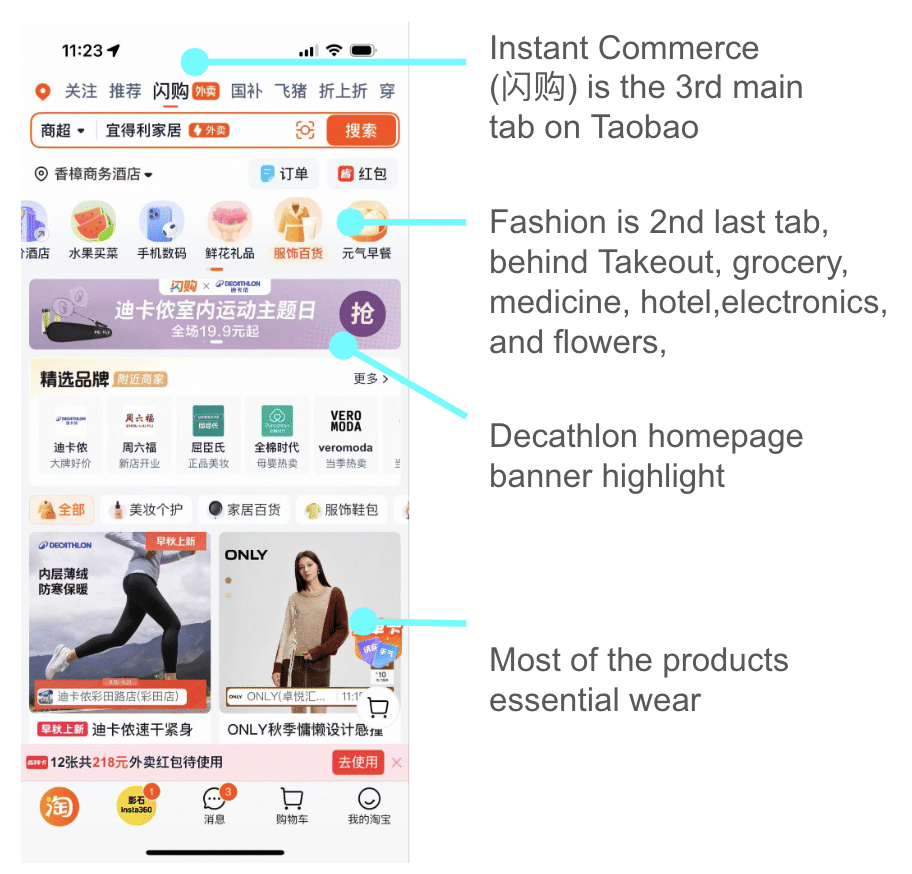
Brands can use warehouse fulfillment, store pickup, or hybrid models depending on product type and local demand during peak shopping.
A Gigantic PR Success
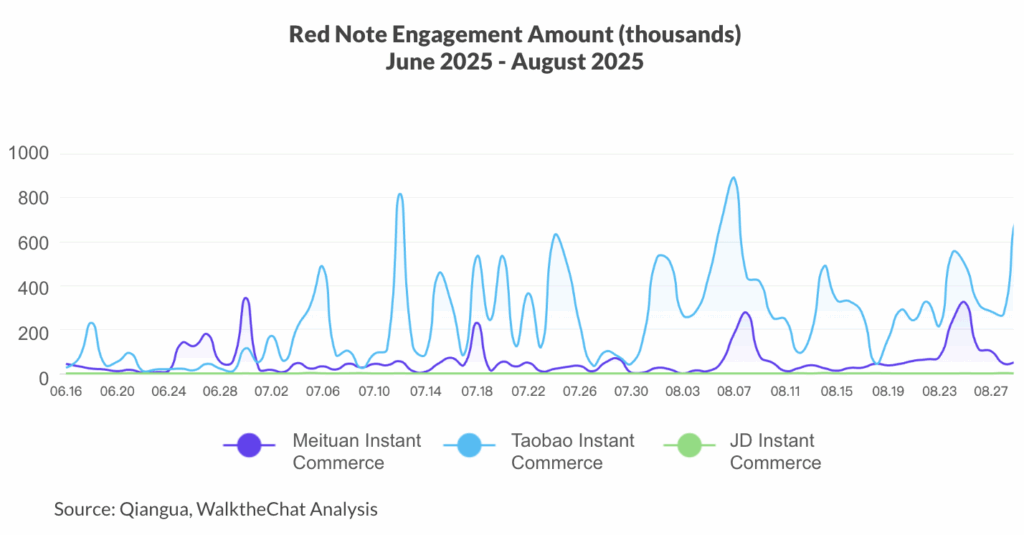
Taobao Instant Commerce was a huge PR success, generating 20.5 million Red Note engagements—4.5x more than Meituan’s 4.5 million.
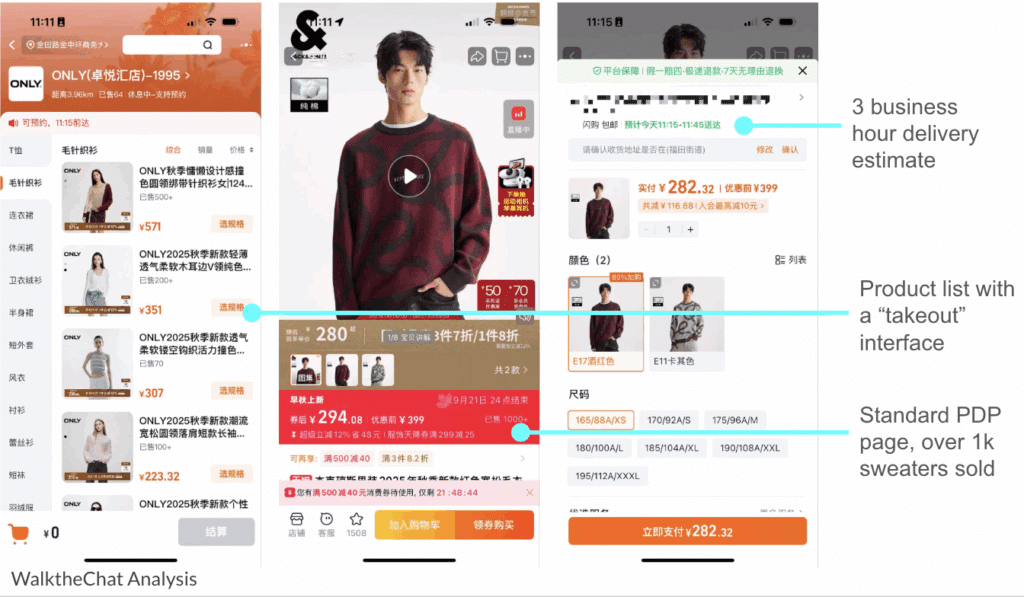
Headlines screamed about 395 non-food brands hitting 1M+ yuan monthly transactions, with fashion brands like JACK & JONES seeing 180% growth, ONLY hitting 300% increases, and VERO MODA exploding 548%.
The type of brands participating in this instant commerce program is, however, limited: mostly domestic players in specific categories (sub-100 RMB apparel, workout gear, last-minute gifts). For premium or international brands, the impact remains minimal.
The Real Play: Behavior Modification
Traditional e-commerce follows a browse-compare-purchase pattern with infrequent high-value transactions, spiking during Double 11. Takeout operates on immediate-need-instant-gratification with frequent, low-value orders year-round.
Users have long had a habit of filling their carts during the year and waiting for Double 11 to make their purchase. Instead, Taobao is trying to establish multiple daily touchpoints that boost spontaneous purchases while building engagement beyond Double 11’s frenzy. Taobao’s goal : maximum user lifetime value through increased purchasing frequency.
Douyin’s Panic Response
Douyin got hit hardest by this war. Unlike JD’s logistics infrastructure or Alibaba’s Ele.me data, Douyin lacks comprehensive delivery systems. Worse, instant commerce threatens their livestream ecosystem—brands already struggle with 60% return rates, and shorter delivery windows could reduce buyer’s remorse refunds.
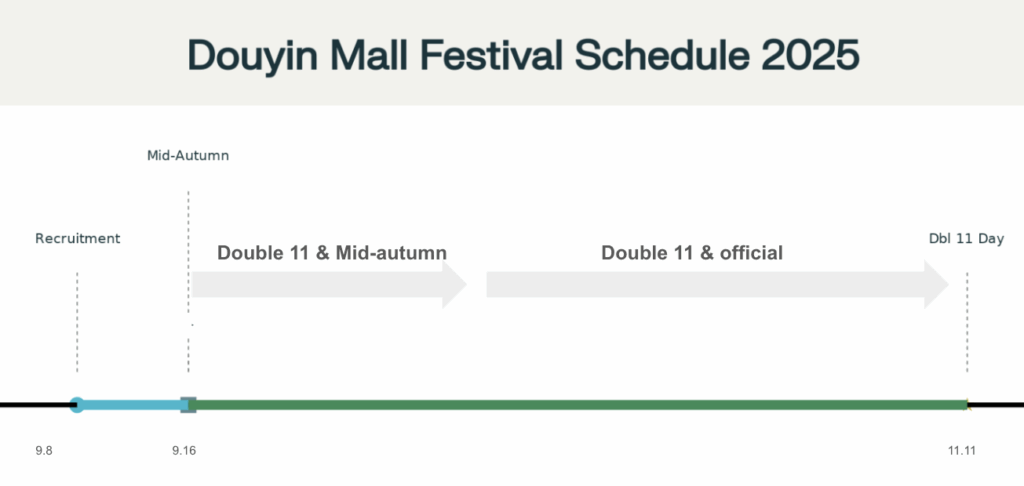
Their response? Aggressive defense. September 2025: Douyin slashed instant commerce requirements from 150K RMB GMV/90 days to just 60 days of stable operation. They launched a 57-day Double 11 promotion starting September 16th—the longest shopping campaign ever attempted—targeting SME merchants in lower-tier cities.
It’s a smart counter-move, but feels reactive rather than strategic.
The Financial Reality Check
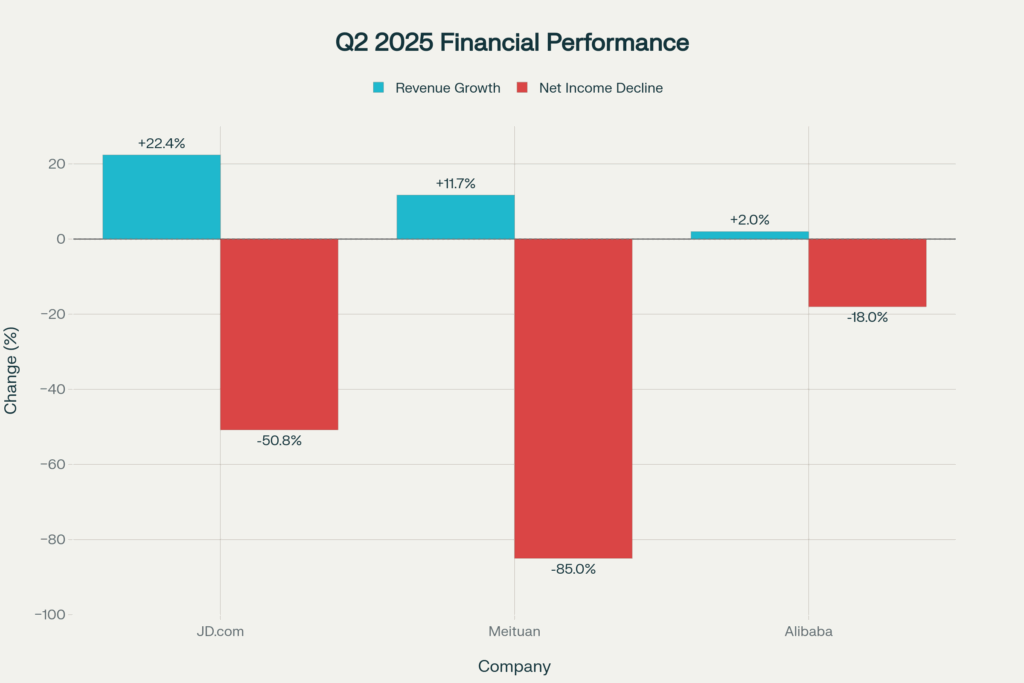
This war created industry-wide profit carnage. Alibaba’s China E-commerce adjusted EBITA dropped 21% to 38.4 billion RMB in Q2 2025—before the July subsidy blitz. The damage spans everyone:
- Meituan: 98% operating profit collapse despite 15% revenue growth
- JD: 51% net income drop despite 22% revenue growth
- Industry total: 80 billion yuan in subsidies from JD and Alibaba alone
Daily order volumes across China’s major instant delivery platforms show Meituan’s continued market dominance despite intense competition
Market positioning shows Meituan still dominating with 130-150M daily orders, Taobao hitting 80M regular operations (120M peak), and JD managing 25M since its February launch. Regulatory intervention hit on September 6th, signaling the end of the most aggressive subsidy phase.
What This Actually Means for Brands
For International Brands this Double 11: Limited immediate impact. Success stories involve domestic brands with offline networks in impulse categories. International retailers face high infrastructure barriers that often exceed immediate ROI.
The Long-term Shift: Taobao’s ecosystem transformation represents a fundamental shift that’ll eventually impact all participants. Post-Double 11 margin pressure will intensify competition, forcing a faster operational pace at lower margins.
Our take for different brand types:
Established international brands with China stores: Monitor competitor Double 11 instant commerce metrics, start tier-1 city pilots post-festival.
Pure e-commerce international brands: Pick your battles. Taobao seems impossible to win directly—double down on social media investment, target your niche community, and collaborate with local F&B brands for visibility.
Emerging brands: Focus on social seeding to build a strong community via social media, while limiting investment to Zhitongche ads within Tmall (brand keyword search ads). Find a local distributor who can be on top of applying the newest Tmall operation tactics while positioning your brand to maintain a premium marketing position.
The Bottom Line
Taobao Instant Commerce succeeds as a PR victory while serving as Double 11’s testing ground for ecosystem transformation. By integrating takeout frequency with shopping behavior pre-festival, they’re conditioning consumers to expect immediate gratification year-round, not just during shopping events.
For brands: immediate Double 11 action might not be necessary, but strategic preparation is essential. Taobao’s play represents the opening salvo in a behavioral dominance battle using Double 11 2025 as proof of concept.
The question isn’t whether instant commerce will transform Chinese e-commerce during Double 11—it’s whether brands will be ready when festival innovations accelerate into mainstream expectations extending throughout the entire retail calendar.
This is just the beginning of a much bigger transformation.