

1. WeChat Mini Program Shop with Active Sales Grow 170% YOY
At WeChat Open Class PRO 2026, WeChat Mini Program Shop reported that the monthly average number of merchants with active sales was 1.7 times the same period last year, and GPM grew to 1.5 times.
In 2025:
- Branded WeChat shop scale growth exceeded the platform growth rate by 4.3 times
- The number of actively sold products in the alliance grew 125% year over year
- The number of new stores introduced by service providers increased 37.6% month over month
- Service providers’ contribution to new-store GMV was close to 50%.
The growth appears to be powered by three compounding levers: product features that “socialize” buying, new traffic entry points inside WeChat, and platform-led operations that accelerate new customer acquisition.
WeChat rolled out commerce mechanics such as “Send as Gift,” “Buy Together,” “Like-to-Buy,” and “Bundle Deals,” which align with how users already interact in WeChat.
During the 2025 shopping festival period, snacks brand Three Squirrels generated RMB 15M in just two weeks solely through ‘Send as Gift’.
Invite three friends to “like” a product, and you unlock a RMB 10 discount at checkout. This kind of incentivized sharing used to be restricted on WeChat, but WeChat Shop is now allowing it as an exception to drive social commerce.

When friends “like” the product, it not only increases the product page impression, but the brand can also launch a re-targeting campaign to convert the “page-view” users.
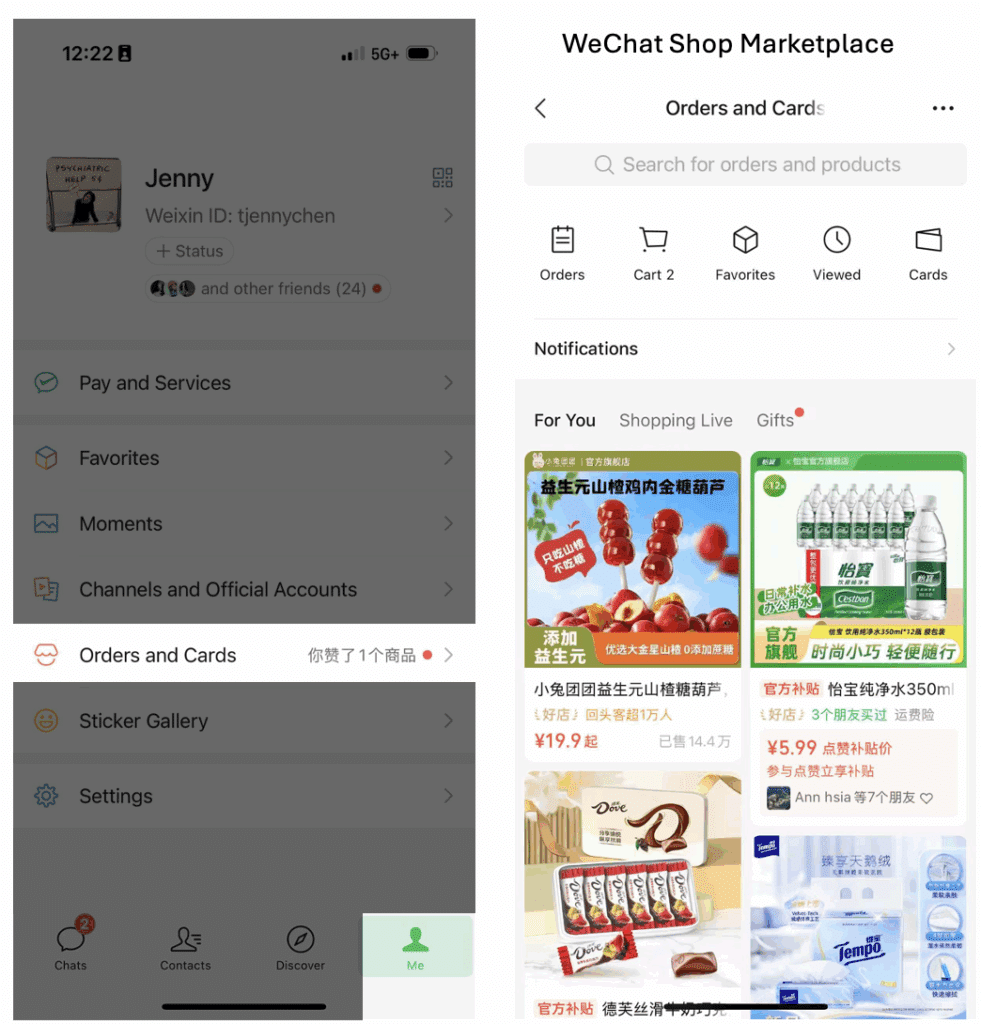
Within WeChat, WeChat’s traffic mix is expanding beyond traditional discovery into high-intent surfaces such as “Orders & Cards” (小店与卡包), Search, Gift Zones, Moments, and social virality loops.
In December 2025, visits to “Orders & Cards” increased 132% vs. August 2025.
For top-tier brands, WeChat is launching Super Brand Day (just another shopping holiday). ERDOS achieved RMB 17M+ in sales in 3 days, with new customers accounting for 88%+ of buyers. This is achieved via collaboration with WeChat Ads, WeChat live-streaming discounts, and in-App promotion.
Although the data looks promising, many products featured in the WeChat marketplace—especially grocery and daily essentials—are priced around RMB 20. For premium brands, it’s often smarter to test the waters first via WeChat Channels live-streaming and a Channels account, before scaling into the broader marketplace.
2. Over 90 companies in 2025 exceeded RMB 10 million in short-drama revenue on WeChat
At the WeChat Open Class PRO 2026 short drama session, WeChat announced it has built an end-to-end integrated solution for the short drama ecosystem.
Data shared there said that in 2025, the number of short drama entities grew by over 31%, and more than 90 companies surpassed RMB 10 million in revenue. Specifically, the number of live-action short dramas was close to 300,000, while the number of comic dramas launched increased by 3,380%.
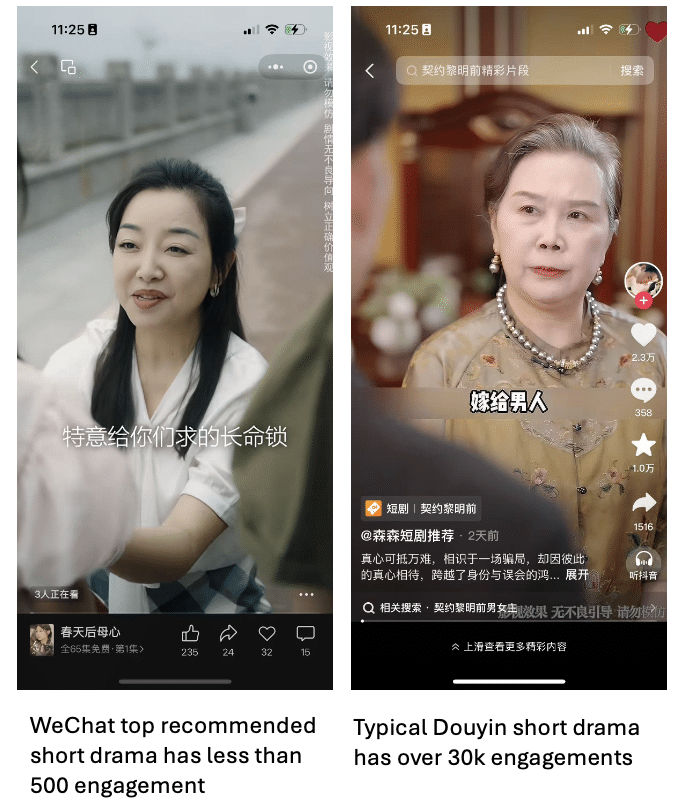
However, WeChat’s short-drama traffic still isn’t comparable to Douyin. Even the most-promoted WeChat dramas often have fewer than 500 engagements, while Douyin short dramas can easily surpass 30,000. As WeChat tries to build out this mature ecosystem, it’s still an open question whether it can realistically catch up.
3. Xiaohongshu quietly tests a “Paid Notes” feature
Recently, reports said that Xiaohongshu has quietly started beta testing a “paid notes” feature. If a note provides enough value, creators can charge readers directly. This is a new exploration of content monetization, aiming to add a creator-to-user paid channel beyond ads and e-commerce.
The current test mainly covers three formats:
- Paid downloads of HD original images (for photographers, illustrators, wallpaper designers, and other visual creators), where users pay to get high-resolution, watermark-free original files for collection or commercial use
- Paid access to a single note for full reading (for in-depth how-to content, industry insights, long-form stories, or novels). Creators can set a free preview ratio, such as the first 20,% and readers pay a small fee to unlock the full text
- Paid unlocking of note collections (for serialized content), where creators can package novels or tutorial series, open the first few chapters for free preview, and users pay once to unlock the entire series—effectively a mini “column” on the creator’s profile.
4. Douyin releases its 2025 tech content ecosystem report: AI-interest users up 105% YoY
The 2025 Douyin Tech Content Ecosystem Report was released, describing changes in Douyin’s tech content ecosystem in 2025.
The report mentioned:
- Demand for tech content increased significantly over the past year, with total annual tech-content views exceeding 1.4 trillion, equivalent to each Douyin user watching tech content more than 6 times per day.
- More than 10 million users learned and improved their AI skills on Douyin
- Views of AI learning content grew 200%.
- Over 17 million users posted nearly 50 million pieces of AI and tech-related content
- Douyin’s AI-interest user base grew 105% year over year.
5. Bilibili ad revenues grew over 20% for 11 consecutive quarters
Bilibili held its 2026 AD TALK marketing partner conference, where Vice Chairwoman and COO Li Ni delivered remarks as a digital human.
Li Ni said:
- Bilibili’s daily active users reached 117 million, and monthly active users reached 376 million
- The average user age is 26, and the average age of new users is 23.
- Last year, more than 220 million users watched consumption-related content on Bilibili, which supported continued ad revenue growth
She said that in a healthy content ecosystem, commercialization is an important component alongside the community and creators. As of last year’s third quarter, Bilibili’s ad revenue has grown over 20% for 11 consecutive quarters; advertiser count continued to increase; retention for million-level clients was close to 90%; and average UP creator income increased 22% year over year.